
Suha Aboul Farag: Bringing a New Model of Financial Leadership to Saudi Arabia
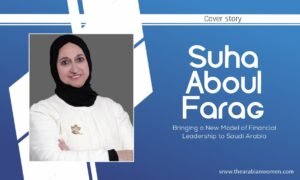
From building banks from the ground up to advancing fintech and financial infrastructure, she is helping define the next era of banking in the Kingdom.
Banking has always asked people to trust what they cannot see. Today, that trust is being tested in new ways as money moves through digital systems, financial services become increasingly technology-driven, and customers expect greater access and speed. For people who have spent decades inside the industry, the real challenge lies in understanding what should change, what should remain familiar, and how the two can work together.
Soha Hussein Aboul Farag began learning that balance long before fintech became a defining force in banking. In 1989, she started her career behind a teller counter in Saudi Arabia, close to the daily transactions and customer relationships that form the foundation of banking. More than three decades later, that first experience has grown into a career spanning traditional banking, trade finance, cash management, fintech and digital payments.
Along the way, Soha managed branches, led regional financial operations and helped establish foreign bank operations in Saudi Arabia, building a career marked by transformation and firsts. Each role brought her closer to a banking sector that was steadily changing around her, from conventional financial services to a landscape increasingly formed by technology and digital payments.
Today, as a prominent banking executive, board member and financial advisor, Soha brings that breadth of experience to the growing fintech arena. Her work sits where technology, regulation and financial inclusion meet, at a time when these forces are changing how the Arab world moves, manages and understands money. Her career, in many ways, mirrors that transformation: it began at the teller counter and has followed banking into its next chapter.
Below are the interview highlights:
Could you take us through your professional journey in banking and financial services and the key milestones that have shaped your leadership career?
I began behind a teller counter at Saudi Cairo Bank in 1989 and worked my way up through branch management, then a decade leading regional trade and cash management at Samba Financial Group and SABB.
In 2013, I founded Connect, my own advisory firm. The defining milestones came later: in 2022, I established the Saudi operations of a foreign bank branch, and negotiated the first-ever property ownership by a foreign bank in the Kingdom’s history.
In 2024, I was appointed CEO of a second foreign bank branch to lead its market entry into the Kingdom. Building two banks from a blank page is the privilege of my career.
With your extensive experience across banking, finance, and economics in the MENA and GCC regions, what major transformations have you witnessed?
I witnessed banking move from paper-ledgers to instant rails. When I started, a cross-border payment took days; today, SARIE settles it in seconds.
Saudi Arabia went from roughly 18% digital retail payments in 2016 to 79%, surpassing its Vision 2030 interim target early.
Equally profound: the transformation of the regulator. SAMA evolved from gatekeeper to ecosystem builder, licensing over 200 fintechs and opening banking data through its Open Banking Framework.
How has your transition from senior executive banking leadership to Chairwoman and Board Member roles influenced your approach to strategic decision-making?
As a CEO, you execute; as a board member, you ask the questions that protect the institution ten years out. The transition taught me restraint; governance means empowering management, not shadowing it.
My board contributions are most valuable when they turn into implemented strategy: at Zamazma Holding, my investment recommendation to establish a Hajj company as a new business line, and the collection-and-payments system with online sales, were both adopted and remain successful today.
What inspired you to establish your financial, cash-management, and recruitment consultancy, and what challenges do you help corporate clients overcome?
After decades inside banks, I saw how much value was lost in the space between corporates and their bankers. Connect was built to close that gap, structuring credit facilities, optimizing cash flow, and building payment infrastructure.
Our proudest work: creating the international package-payments system for Hajj and Umrah pilgrims, still the only one of its kind operating today, and introducing electronic bank guarantees to the sector, cutting time and cost dramatically.
How is fintech reshaping traditional banking models across the MENA and GCC markets, and what opportunities do you see emerging?
Fintech has unbundled the bank. Payments went first; BNPL champions like Tamara and Tabby became unicorns by owning a single customer moment.
The opportunity now is in what remains underserved: SME finance, which Saudi Arabia aims to lift from 5% to 20% of bank lending; cross-border remittances; and embedded finance, where banking disappears into the platforms people already use.
Which fintech technologies or innovations will have the greatest impact on banking, payments, and cash management in the coming years?
Three stand out. Open banking APIs, with SAMA’s payment-initiation services now live and the first licenses granted, will redefine who owns the customer relationship.
AI will transform credit decisioning, fraud detection, and compliance. And digital trade instruments, an area close to my heart, having pioneered electronic bank guarantees, will finally modernize corporate banking’s least digital corner.
How can traditional financial institutions and fintech companies collaborate more effectively?
Banks bring trust, licenses, and balance sheets; fintechs bring speed and customer obsession. The collaboration fails when each tries to become the other. It succeeds through honest partnership, banks providing rails and regulatory strength, fintechs owning experience. My
Hajj payments network worked precisely because we integrated with government ministries rather than around them. Partnership beats disruption in regulated markets.
What are the most important considerations around risk management, governance, cybersecurity, and regulatory compliance in digital finance?
Compliance must be a foundation, never a retrofit. Having twice built banks in Saudi Arabia under SAMA’s supervision, I structured cybersecurity, AML, and risk functions before the first customer transaction.
Boards must treat cyber resilience as a standing agenda item, not an IT matter, and third-party risk deserves equal rigor; a bank today is only as strong as its weakest integration.
What leadership principles have helped you build high-performing teams and inspire trust, confidence, and loyalty?
Hire character, train skill. Give people clarity about the mission and genuine ownership of their piece of it. And never ask anyone to do what you would not do yourself. I started as a teller, and my teams know it. Loyalty is not demanded; it is earned by developing people until they outgrow the roles you hired them for.
As a woman who has reached senior executive and board-level positions in finance, what challenges have shaped your journey, and what lessons have you gained?
I entered Saudi banking when women’s roles were confined to ladies’ branches, and I managed those branches, then refused to let the ceiling follow me into trade finance and treasury.
The lesson: excellence is the argument no one can dismiss. Every “first” I achieved was won by being demonstrably prepared, and by resilience when doors closed slowly.
What steps can financial institutions take to create stronger pathways for women into senior leadership and board positions?
Move from mentorship to sponsorship; women need leaders who advocate for them in rooms they are not yet in. Set measurable board diversity targets and report against them.
Saudi Arabia’s progress under Vision 2030 proves intentionality works: female workforce participation exceeded its target years early. What is measured improves.
Looking ahead, what major trends will define the future of fintech and financial services across the Arab world?
A fully cashless GCC is within reach; Saudi Arabia targets 80% by 2030 and is nearly there. Open banking will mature into open finance, spanning insurance and investments.
Islamic fintech will scale Sharia-compliant products digitally. And I expect regional champions to consolidate and expand cross-border, making the Arab world an exporter of financial technology, not just an adopter.
What advice would you offer the next generation of women leaders who aspire to make an impact in banking, finance, and fintech?
Master the fundamentals first: credit, risk, operations. Technology changes; sound judgment compounds. Say yes to the hard assignments others avoid; they are where reputations are built. Guard your integrity absolutely, because in finance it is the only asset that cannot be rebuilt. And lift other women as you climb.
As you continue your work as a Chairwoman, Board Member, and financial advisor, where do you hope to create meaningful impact?
Three areas. First, guiding foreign banks entering Saudi Arabia, a specialty I have now practiced twice. Second, digitizing the Hajj and
Umrah economy, a sector I have served through boards, advisory work during the pandemic, and payment infrastructure, as the Kingdom prepares to welcome ever-greater numbers of pilgrims. Third, strengthening governance and bringing more women onto boards.
What would you consider your most significant contribution to the industry, and what legacy would you like to build?
The payment network serving pilgrims from around the world, built years ago and still the only one operating, because infrastructure that outlives its builder is the truest measure of contribution.
My legacy, I hope, is twofold: two banks standing in Saudi Arabia that I built from license to launch, and a generation of bankers, many of them women, who saw that the path from teller to CEO is real.