
Hadil Al Khatib: Reconceptualising Everyday Health Through Conscious Food and Wellness
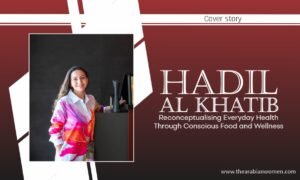
How Hadil Al Khatib brings ancestral food wisdom, gut health education, and purpose led wellness into the everyday rhythms of modern life.
Gut health may now be part of the everyday wellness conversation, but the real test of any approach to food comes when a person is tired, overwhelmed, and looking for something that helps them feel more like themselves again. For many women after childbirth, that search can be lonely. Symptoms can be hard to explain, and advice can leave them feeling as though they simply have to cope. Hadil Al Khatib knows that feeling firsthand.
At 28, while working in the corporate energy sector, she could not have imagined that she would one day be known across the UAE as the “Broth Queen.” Her turning point was deeply personal. After giving birth, Hadil went through a difficult postpartum period. She was exhausted, depleted, dealing with severe gut issues, brain fog, and chronic fatigue, and she no longer recognised the version of herself she had always known.
“I was told, “You are a new mum. Take this pill and you will manage.” But I was not managing. I was merely surviving.”
Hadil began searching for answers that felt more complete. She immersed herself in holistic nutrition, gut health research, and traditional functional foods. Slowly, she returned to the kinds of practices that had always made sense in family kitchens: long simmered bone broth, clean free range poultry, simple nourishing meals, and the patience to give the body what it needs. She says the change was profound. It did not just help her regain her energy. It brought back her fire.
That experience gave her both purpose and a very human kind of anger. Why, she wondered, had so much basic wisdom become so difficult to access? Why were women expected to carry on quietly when they were struggling? She decided that her healing would not remain a private story. It would become the work of her life.
Today, Hadil is a Certified and Licensed Gut Health Coach and the founder of The Broth Lab, The Roost Rotisserie, and Catcha Matcha. Her businesses are award winning, but what matters most to her is what they stand for: a gentler, more practical way of helping people care for themselves.
Returning to What Was Once Understood
Hadil often speaks about the relationship modern life has lost with food. In a world built around speed, she feels that many of us have lost touch with patience, simplicity, and the quiet comfort of making something well.
“Modern society fell in love with convenience and completely divorced itself from patience.”
She says we traded our grandmothers’ heavy earthenware pots for microwaveable plastic and ultra processed protein bars with barcodes longer than our attention spans. Earlier generations did not talk about the gut brain axis or cellular autophagy, but they understood something important through lived experience. They knew that good food takes time. Broth was simmered for hours. Wild olives, seasonal vegetables, and kefir were fermented. Meals were shared, not rushed.
Hadil does not romanticise the past for the sake of it. She simply believes that some old habits were wise because they were built around care. Food was seasonal, communal, and made with attention. By contrast, many people now eat while answering emails late at night and then wonder why their digestion, sleep, and energy feel out of balance.
“Food is not merely calories or macros. It is information and communication with your cells.”
For Hadil, the question is not whether we should go backwards. It is how we can carry the useful parts of that wisdom into busy modern lives without making wellness feel like another impossible task.
When Wellness Becomes Another Source of Pressure
Hadil is open about the fact that her own approach has changed. In the beginning, she says, she was more strict. Like many people who discover wellness after a difficult health experience, she wanted to do everything perfectly. The cleanest meals, the best routines, every box ticked.
Then life got fuller. She was raising children while building three businesses, and the idea of perfect wellness stopped making sense.
“Wellness cannot be a full time stressor. If your health routine causes you more anxiety than your daily workload, it is an illness masquerading as self care.”
These days, Hadil talks about wellness in a softer way. She values routines that are sustainable, a calmer nervous system, and the kind of joy that makes a habit worth returning to. She believes small, consistent choices can do more for a person than a rigid plan they abandon after two weeks.
There is one thing she will not compromise on: integrity. Whether she is sourcing antibiotic and hormone free local poultry for The Roost Rotisserie, making bone broth at The Broth Lab, or sourcing single origin ceremonial green tea from volcanic Japanese soil for Catcha Matcha, she brings the same standard to the table.
“If an ingredient is not good enough for my own children’s kitchen table, it never touches my customers.”
Understanding the Gut as a Whole Body System
Hadil calls the gut the body’s “biological control tower.” She believes people often separate things that the body experiences together: digestion, energy, mood, skin, sleep, hormones, and stress. In her view, the gut is not an isolated part of the body. It is part of a much bigger picture.
She speaks often about how gut health can connect to the way people feel day to day. Someone may be dealing with bloating, brain fog, low energy, skin concerns, anxiety, or changes in mood, and they may not realise how many parts of their routine are affecting one another. Her approach is not about promising a quick fix. It is about helping people notice patterns, nourish themselves more thoughtfully, and seek appropriate professional care when needed.
Hadil has seen clients relying heavily on oat milk lattes, deli meals eaten on the go, and artificial protein bars grabbed between meetings. When they begin adding more diverse prebiotic fibres and warm, nutrient dense meals such as broths, soups, and stews, many tell her they feel clearer, steadier, and more connected to their bodies.
“You cannot separate mental health from metabolic health. Heal the gut, and you support the whole human.”
Moving From Information to Practical Understanding
For Hadil, the problem is not a lack of information. There is no shortage of videos, podcasts, posts, and opinions about health. The difficulty is knowing what matters, what applies to your own life, and how to make a change that actually lasts.
“Information is everywhere, hello AI. However, wisdom and transformation are scarce.”
A person can watch hundreds of videos about insulin resistance and still find themselves reaching for a bag of chips at midnight when they are stressed. Hadil understands that this is not a failure of character. It is what happens when information is not matched with real support, realistic habits, and self compassion.
Her work is about translating complex nutritional science into everyday rituals. She pairs it with ancestral logic and tries to meet people where they are: sitting in Dubai traffic, moving through back to back meetings, or managing a school run. She wants wellness to feel possible, not intimidating.
The question she hopes people ask is not, “How can I punish myself with another diet?” It is, “How can I deeply nourish my body today, without striving for perfection, so I can show up for my life?”
The Myth of the Complete Overhaul
Hadil calls it the “insidious myth of the overnight overhaul.” We live in a culture that loves dramatic before and after stories. People expect a thirty day transformation, sign up for a punishing 5:00 AM boot camp, clear out the pantry, drink only celery juice, and then feel defeated when the plan becomes impossible to maintain.
She believes the real problem is usually not a lack of discipline. It is the gap between an extreme plan and a real human life. That gap is where consistency gets lost.
Instead, she encourages micro rituals. A second anxious morning espresso on an empty stomach might become a mug of bone broth. Dessert might sometimes become a ceremonial matcha with coconut milk and sidr honey. An evening meal might be accompanied by a warm cup of chicken bone broth. These are not rules. They are small invitations to choose care more often.
“Small, joyful wins create momentum. Perfectionism creates burnout.”
Ancient Principles, Modern Explanations
“Ancestral wisdom gives us the what. Modern science provides the why.”
For generations, grandmothers made chicken broth for people who were sick, tired, or depleted. Modern science gives us more language for understanding the nutritional value of the ingredients and the importance of hydration, protein, and regular meals. For Hadil, that does not mean the old wisdom was less valid. It simply means we can now understand it from another angle.
“Wonderful, science. Our grandmothers already knew it, just without the white lab coat.”
The combination of old knowledge and modern thinking is at the heart of The Broth Lab and Catcha Matcha. Hadil describes it as “ancient alchemy built for the modern pace.” It is a way of keeping traditional care accessible to someone commuting to work or moving through a busy day in the DIFC.
When Purpose and Commercial Value Work Together
When Hadil entered the food and beverage industry with clean concepts, she says some investors and peers were sceptical. She was told that healthy food would not sell in the region and that people wanted deep fried fast food.
Ten years, multiple homegrown brands, and several industry awards later, she feels that her experience has proved otherwise. People do want convenience, she says, but they also want food they can trust and brands that reflect the way they want to live.
Hadil believes purpose and profitability need each other. A business with strong values but no operational discipline will not survive long enough to make a difference. A business focused only on profit will struggle to earn lasting loyalty.
“If your brand does not create genuine impact and improve people’s everyday lives, you have no long term loyalty. But if you have noble intentions without operational discipline, unit economics, and profitability, your impact dies in the garage.”
“You are not just selling a product. You are building trust, and trust is the most durable currency in business.”
Resilience as a Leadership Foundation
Hadil describes her experience as an Arab woman in food and beverage operations, commercial real estate, and finance as a masterclass in resilience. She remembers boardrooms and supplier meetings where people looked past her, searching for the “real boss,” or dismissed her passion as emotion.
Her Palestinian heritage and Emirati ambition have shaped the way she understands perseverance. To her, resilience is not a polished business word. It is the ability to keep creating when the ground is difficult, to build from what is available, and to move forward even when the path is not smooth.
Those experiences have made her clear about the kind of leader she wants to be. She does not believe in driving people into the ground. She believes in transparency, humanity, and standing with her team when things are difficult. She wants people to feel proud of what they are building and to know that their work matters.
The Duty That Comes With a Larger Platform
Hadil’s experiences on Shark Tank, Forbes, and TEDx gave her access to a larger audience, but they also made her more aware of responsibility. She saw that the search for honest health solutions had moved beyond a small wellness community. People were hungry for something more grounded than empty promises.
Winning on a platform such as Shark Tank, she says, was meaningful not only for her but for every purpose led founder who has been told that their idea is too niche or too wholesome to compete. It gave her a bigger microphone. She is mindful of how she uses it.
Hadil says she will not use her voice to sell miracles or make people feel insecure about themselves. She wants women and families to feel that health is their birthright. She also wants emerging female founders across the GCC to know that they can build commercially strong businesses without abandoning their values.
Navigating the Noise of Social Media Wellness
Hadil calls social media wellness “a circus.” One day fruit is celebrated as a superfood. The next, an influencer with a ring light says an apple is toxic because of lectins and suggests raw butter instead.
Her way through the noise is simple. She asks people to consider time and incentive. Has a food or practice supported people for generations? Is the person sharing advice trying to educate, or trying to create a new insecurity so they can sell something expensive?
Real wellness education, she believes, should feel grounding. It should help people feel more confident in their ability to care for themselves, not more frightened of ordinary food.
“If an online trend makes you feel anxious, inadequate, or paranoid about everyday food, mute it immediately.”
Redefining Hospitality Through Nourishment
In the Arab region, food is much more than fuel. It is hospitality, family, celebration, generosity, and love. Hadil respects that deeply. “We love big, and we feed big,” she says.
She is not asking people to lose that warmth. She wants nourishment to become part of it. In her view, offering whole, nutrient dense food to someone is one of the most loving things we can do. Hospitality can still be abundant and joyful while also helping people feel good after the meal is over.
She would also like to see nutrition and culinary education given more space alongside clinical care. Prevention, she believes, begins long before a diagnosis. It begins in family kitchens and at the dining table, three times a day.
Building the Future from the Roots Up
Hadil wants wellness education to become part of everyday life, including schools and family kitchens. She believes it should be basic human literacy, not a luxury trend reserved for a privileged few.
Her message to young women and aspiring female entrepreneurs is simple and heartfelt.
“Please stop waiting for permission or a perfectly paved road. When you step out to build something that honours health, tradition, and purpose, you will face plenty of scepticism, but that should never become a reason to delay the work.”
“Build anyway. Trust your gut, literally and figuratively.”
She encourages founders not to trade ethics or intuition for rapid but hollow scale. The businesses worth building, she says, are the ones that heal, lead with integrity and joy, and remain close to the values that first gave them meaning.
“You do not need to reinvent the wheel to shape the future. Sometimes, the most revolutionary thing you can do is look back, remember who you are, and build from the roots up.”